From institution to destination: How Tagesspiegel is rebuilding the reader relationship
For the 21st century newsroom, change is a constant. Publishers have pivoted, innovated, adopted and adapted to a barrage of threats and challenges over the past three decades.
In this interview by Chloe Tsang for the Future Newsrooms Study, Tagesspiegel editor-in-chief Christian Tretbar explains how the German news organisation is meeting core challenges head on, with a team unified in strategic objectives.
Last year, Tagesspiegel (‘Daily Mirror’) celebrated its 80th birthday with a ‘High Noon’ discussion on the future of journalism – and including a 2020 special feature on the worst mistakes made in the daily’s earlier lifetime. This week, it made local headlines with the revelation that it had dropped, “until further notice,” a political columnist – a former editor-in-chief – for undisclosed use of AI.
Tagesspiegel’s handling of the matter is on par with its strategic focus on regaining trust by boosting engagement – and being concise and transparent about it.
First published on 27 September, 1945, the German newspaper boasts 394,000 daily readers, 7.46 million monthly unique users and more than 100 products in its portfolio.
The Berlin-based publication enters its ninth decade with a firm focus on transformation, starting with a top-down restructure last year that positioned Christian Tretbar as the sole editor-in-chief in January 2025.
Tretbar has been with Tagesspiegel since 2004, and had been co-editor-in-chief (with Lorenz Maroldt) for four years, primarily focusing on digital transformation and change management within the newsroom. His first year as Editor in Chief has been focused on a total newsroom reset and in January, Tretbar indicated its direction when he took over the paper’s WhatsApp channel to promote and encourage direct engagement.
Consistently transparent: Tagesspiegel produced a special 75th anniversary edition reflecting on past mistakes – and republished this on their 80th birthday.
Next: One team, three missions
A major priority for the year was a complete overhaul of the product development process and in April, Tagesspiegel formally launched a new unit called Next, bringing much of the previous year’s strategy and planning into daily practice.
“That’s maybe one of our most important projects for this year: to get faster, to get better and to get more oriented at our main KPIs,” explains Tretbar.
This involved a merger of the product management and subscription units into editorial, and the establishment of a completely transformed newsroom.
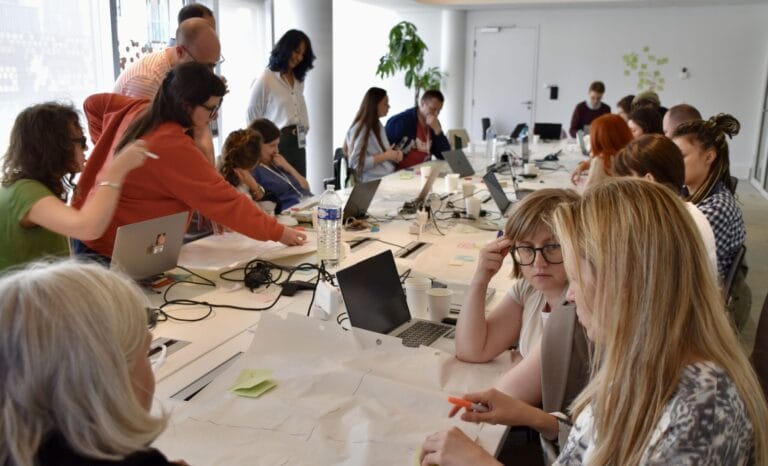
Integrating editorial staff, technologists, data specialists, product managers and subscription teams has increased collaboration, leading to new perspectives that are challenging and strengthening editorial priorities and practices, notes Tretbar.
“Cross-functional teams are developing their own workflows and reporting structures, driving a significant cultural shift within the organisation.”
Reclaiming the audience
Next is governed by three interdisciplinary missions: focused on audience, subscription, and engagement, which report to a general lead – which itself comprises two vice editors-in-chief and a chief product officer.
“It’s a complete change in the way these missions are working right now. Each mission has a main KPI focus: the audience team focuses on owned traffic; the conversion mission targets conversion rates, and the engagement mission aims to reduce the churn rate,” explains Tretbar.
With this, “We get much more sovereignty back in the editorial team about how our content is distributed, how our editorial products are built and developed, and for which goals they are developed,” he adds.
Those goals also include regaining sovereignty from Google by gaining more direct or “owned traffic,” and the entire unit is strategically aligned to a unified focus.
Sold Out: The newsletter that became a show
The engagement unit combines diverse editorial capabilities, from storytelling and video production to newsletters, live events and community-building.
These functions work together to deepen audience engagement, with community playing a particularly important role in fostering subscriber loyalty and long-term retention.
“Our community is not just an on-site community,” notes Tretbar, pointing to a thriving B2B (business to business) sector with more than 100 live events per year.
Among their various engagement activities – from newsletters to video formats – they’re now trialling B2C (business to consumer) or, as Tretbar says, ‘business to user’ events, and experimenting with live, interactive events that “doesn’t have to do anything with storytelling; it’s about how we can engage our community, and how can we make our community even brighter and bigger.”
Tagesspiegel started with two major events in Berlin: Hop, a political/cultural talk show “that has a lot of feedback loops” online, and a regular Berlin Revue, based on their popular Checkpoint newsletter, a core product. This entertainment show, complete with house band, quizzes and more, runs four or five times a year: “and every show is sold out.”
A third element, also on trial, is an interactive digital offering called High Noon, a live video talk with experts on international subjects, is also interactive.
“These are very quick events; we can set them up in one or two days, and they are all especially for subscribers.”
It’s all a work in progress, notes Tretbar – as is the daily exercise of executing longterm strategy, which requires constant reinforcement: “It’s not enough to give people the strategy, to tell them ‘What are we doing?’ and ‘Where do we go?’ You have to have that on the street, every day, in each conference. You have to ask, ‘Is this what we want from our strategy?’
AI as strategic ally
And as for AI? “For me AI is more of a possibility than a threat, but you have to deal with it responsibly,” notes Tretbar, adding that AI can also help “to get the strategy on the street” – explaining how Tagesspiegel developed a Chatbot assistant to help the team align daily activities with strategic objectives to better reach target audiences.
The contentious AI articles have been removed, and Tagesspiegel builds on a newsroom restructured around loyalty, community and owned relationships – for the next 80 years.
An extract from the Future Newsroom Study