‘We have never deviated’: Amedia plays the long game to digital subscription success
In an industry where speed and agility are all the rage these days, Amedia, Norway’s largest local media publisher, stands out with its 14-year-old strategy that continues to bear fruit.
Around 2013 and 2014, the Norwegian publisher found itself in a difficult situation. “We were basically about to go bankrupt,” said Anders Opdahl, CEO of Amedia.
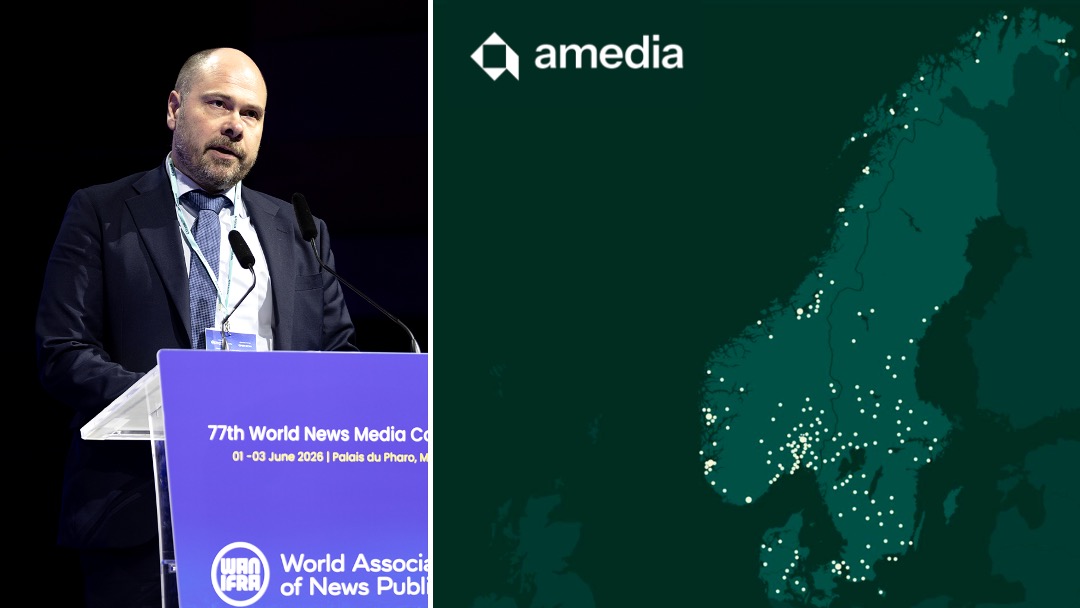
Speaking at our recent World News Media Congress in Marseille, he said that the company had to make “some really hard decisions” at the time. Remarkably, those decisions still signpost the company’s strategy today.
“We have been extremely loyal to the few decisions that were actually meaningful for us. And we have never deviated from them,” Opdahl said.
For instance, the company has emphasised the long view over the short-term: over the years, “we have said ‘no’ to a lot of the hype stuff, and been very focused on what we believe are the long-term challenges and the long-term strengths for our business,” he said.
Amedia also had to take risks and move fast, whereas some of their competitors with more stable financial situations had the luxury of taking things “in a slower manner,” he said.
“And that has worked out extremely well for us,” he said. “So, never underestimate the value of a good crisis!”
WAN-IFRA Members can view Opdahl’s presentation on our Knowledge Hub.
Amedia recently announced its 2025 results: EBITDA surged 52% to NOK 593M (€54M), up from NOK 390M (€35M) in 2024.
The road to +Alt
Some important outcomes from those early decisions include the construction of a “really strong, consolidated technical backend,” as well as a “heavy investment in data.”
Thanks to the latter, Amedia now has first-party data on about 2.8 million of the 5.4 million people in the country. Moreover, 87% of their pageviews are from logged-in users.
“We know what the users are doing,” Opdahl said. “That’s really important when it comes to creating commercial products and advertising. But first and foremost, it’s a key differentiator to create the right kind of product.”
During the first couple of years of the new strategy, the goal was to create a strong foundation that would allow scaling up. More recently, growth has become a central focus.
In 2019, the company had a portfolio of about 70 newspapers in Norway. It now holds a majority or minority stake in almost 260 titles across Norway, Sweden and Denmark.
While many media houses with broad portfolios are building synergies across their titles, Opdahl said these efforts tend to focus on the technical backend. For Amedia, they extend to the frontend as well, which makes it “quite different from a few other companies.”
The most obvious example of this is the 2020 launch of +Alt, Amedia’s bundle product that gives access to content to all of the company’s newspapers and websites in Norway.
Read more: How Amedia fine-tuned a bundled subscription product to meet reader needs
Opdahl said that +Alt was a way of taking advantage of “the commercial and editorial potential of being on one platform.”
Today, the basic bundle includes more than 100 newspapers. A Premium version adds access to live sports (the company broadcasts about 6,000 sporting events a year) and to the company’s podcast platform. Amedia also offers a personalised news feed app that features stories from their full range of newspapers and websites.
80% of subscriber revenue from digital
For any bundle product, determining the appropriate price can be a tricky affair.
Going back to their crisis years, before the launch of +Alt, Opdahl explained that the company had to adopt a very practical approach to pricing.
“When we set the price back in 2013-2014, it was from a point of economic hardship. So, the whole decision process was really easy: to survive, we had to charge the market between 20 and 25 euros for a single digital monthly subscriber,” he said.
“And then the problem to solve was, how do you create content value to actually get people to pay that amount of money?”
By the time +Alt was launched, things had turned around and the company was already having “quite high success in the digital news media market,” Opdahl said.
Today, a monthly subscription to +Alt costs 299 Norwegian crowns (about 27 euros) or 349 crowns (32 euros) for the Premium version.
All in all, the bundle has only accelerated Amedia’s digital transformation: 80 percent of their subscription revenue now comes from digital subscriptions, Opdahl said.
‘This is a model that works’
Going back to the benefits of having all the media houses titles on one platform, Opdahl said that the company’s tech integration also extends to the user experience on individual titles’ websites and app, where any relevant content also from other titles can be presented.
Meanwhile, the investment in the data structure – providing a view on a local, regional and national level – has been a key component for identifying useful signals in the data.
The company-wide backend is also an asset when it comes to AI and dealing with AI providers, Opdahl said: “One thing is of course negotiating deals across our media companies towards the global players.”
“But I also think it’s important to create strong backends and strong infrastructures to be able to have meaningful discussions with global [AI] actors.”
Finally, Opdahl highlighted Amedia’s revenue-sharing arrangement for bundle sales: “All the earnings that we create by selling this collectively are distributed back to the selling newspaper,” he said.
“It’s highly important, so that the whole organization – journalists, editors, commercial people –are highly incentivised to actually stand for the whole,” he said, adding that the same sharing principle applies to costs, based on transparent and fair distribution.
Ultimately, the results speak for themselves.
Out of Amedia’s 850,000 subscribers in Norway, about 60 percent have the +Alt product, Opdahl said.
The company is also taking the bundling approach outside Norway’s borders, first by launching it in 2022 in Sweden (with Bonnier News Local, which Amedia is a co-owner of), and in 2026 in Denmark (with Berlingske Media, which Amedia acquired in 2024).
Although he didn’t share figures, Opdahl said the first results “have been really, really impressive,” proving that the advantages of the bundling strategy are not limited to the Norwegian market.
“So this is a model that works, and it’s not only a Norwegian phenomenon, it’s a cross-border phenomenon,” he said.