Beyond the frontline: Addressing the hidden trauma of newsroom leadership
At some point on Monday night, as Anna Babinets sat in Marseille preparing for a panel session at the World News Media Congress, bombs were falling across Ukraine. By morning, the apartment her news team uses had been destroyed.
Her phone lit up as her plans to attend the morning sessions collapsed. ”I started calling everyone, to decide what to do; should we rent another apartment…?”
It didn’t occur to her to miss the session she was scheduled for. Because this, she explained later from the stage, is simply what the job looks like now. “You should be ready for everything, and more.”
As Regional Editor of Ukraine’s Organized Crime and Corruption Reporting Project (OCCRP) and co-founder and editor-in-chief of Slidstvo.Info – an investigative centre based in Kyiv – Babinets has spent 14 years on “hard content” such as the Panama Papers, investigations into murdered colleagues, and four years of full-scale war.
“Of course, you are never prepared for the war that comes to your home. But we were prepared to work with hard stuff,” she confirmed.
What she was less prepared for, she admits, was the specific weight that falls on the person running the newsroom, rather than working in it.
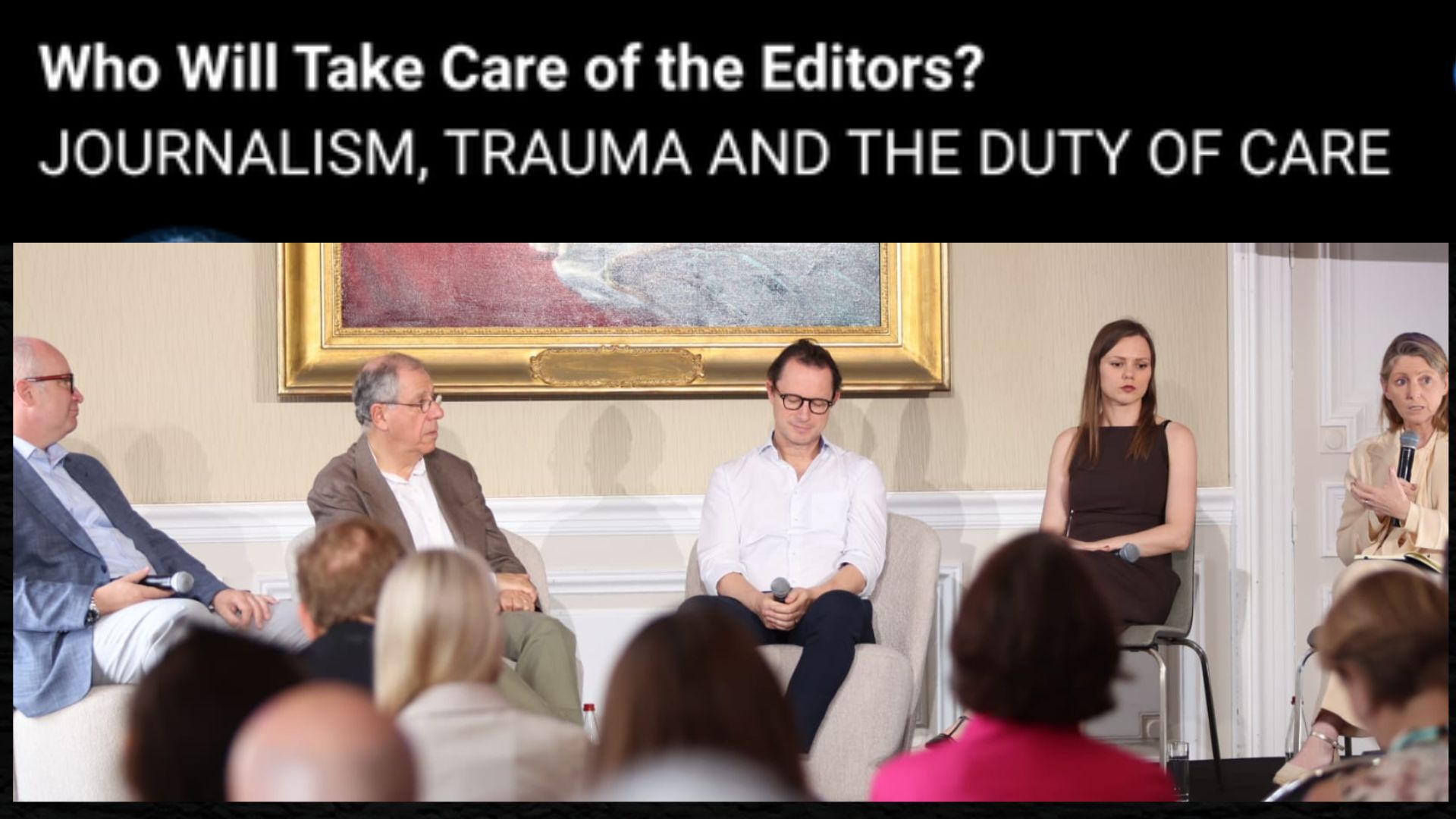
This was the focus of the panel session on “Who takes care of the editors” – a session that delivered resounding data, experience, insights, tools and resources to help newsrooms better understand and manage this lesser-discussed phenomenon.
Moderated by David Walmsley, editor-in-chief of Canada’s Globe and Mail, and President of WAN-IFRA’s World Editors Forum, the panel included Phil Chetwynd, Global News Director for AFP and specialists: Anthony Feinstein, Professor of Psychiatry at the University of Toronto, and UK-based International Human Rights lawyer, Caoilfhionn Gallagher.
Professor Feinstein has led research into war reporters and PTSD for nearly three decades. He introduced the concept of “moral injury” – and led the development, with colleagues in London and Toronto, of the Toronto Moral Injury Scale for Journalists; the first tool designed to measure the condition.
This year, he replicated findings from studies done in Kenya, Mexico, Afghanistan, Iran and more, to reveal that: “the data hadn’t changed”: the rates of post traumatic stress disorder and depression and anxiety are much higher in journalists than they are in the general population.
Feinstein outlined the stressors, conditions and warning signs underlying the data, highlighting the additional stressors that fall on editors who carry the “moral duty” of keeping journalists safe when sending them into difficult conditions.
Recognising real risk
Feinstein also pinpointed the various challenges arising from editors having to deal with traumatised journalists, underlining the crucial need for institutional support, and to eradicate the stigma of accessing therapy. “You are not schooled in violence. And yet, you are the interface with many violent things in our society all the time. So violence becomes very much part of your work and environment,” he pointed out.
Renowned for leading global cases of human rights abuses against high profile clients including Nobel laureate Maria Ressa, Jose Rubėn Zamora, Jimmy Lai, and Mzia Amaglobeli, International Human Rights Lawyer Caoilfhionn Gallagher has extensive experience in aiding journalists in crisis situations.
She expanded on Feinstein’s stressors and challenges by highlighting four primary risks editors face:
Identifying the issue
As global news director for AFP, Phil Chetwyn is responsible for some 1,700 journalists in over 150 countries, and he has long had to confront safety, security and trauma challenges head on – and has been open about the difficulties of doing so.
Chetwynd has been spearheading a culture of awareness within the news agency – a “newsroom must”, according to Feinstein.
“The first big change was to identify that problem, put budget behind it, and bring in people to help your newsroom,” he summarised. “And then as a leader, you have to walk the walk because no one’s going to follow you unless you are vulnerable enough to talk about these issues and keep talking about these issues so that the culture of the company changes.”
All panelists proffered practical strategies and recommendations for both personal and professional wellbeing, emphasising the need for awareness, self-care and wide support.
Recommendations for editors: Anna Babinets’ tried and tested three-pronged approach to wartime selfcare
- Set and maintain clear boundaries: Maintain very strict separation of work and personal time, and respect journalists’ time off.
- Pursue normality: Encourage journalists to live a normal life (cinema, reading) and view their work as a marathon, not a sprint.
- Peer support: Anna established a “manager’s club” where editors can share pain, complain, and discuss difficult issues like hiring and motivation of staff.
For newsrooms: Strategies for organisational change
- Culture and support: News organisations must provide confidential access to therapy, reduce the stigma around emotional distress, and establish peer support groups for editors.
- Leadership and collaboration: Leaders must set a sensitive tone, talk about the issues, and be vulnerable to influence company culture. Editors should collaborate with rivals on non-competitive issues like security and stress management, as this sharing alleviates a “huge burden”.
- Self-Care for editors: Simple steps include controlling the “micro environment” (sleep, exercise, appetite) and dedicating time to socialising, family, and hobbies. “Good relationships are the single biggest protective factor for emotional health,” notes Feinstein.
These recommendations are given further weight by preliminary findings, released last week, from online global survey by the Reuters Institute, which stressed that drone attacks, digital surveillance and war rhetoric means “conflict journalism is no longer restricted to battlegrounds” – and warned that the impact of various traumas journalists are exposed to calls for further education and deeper institutional support.
See Also: Normalise, remind (repeat), educate: Trauma solutions for newsrooms
And: When the killing of journalists disrupts nothing: a conversation with safety expert Elena Cosentino