Service journalism that actually pays off – lessons from Canada’s Village Media
By Niklas Jonason
Village Media is a Canadian digital media company headquartered in Sault Ste. Marie, Ontario, that operates an extensive network of hyperlocal online news and community websites.
Founded by CEO Jeff Elgie, the company employs a reach-based, ad-supported business model that prioritises community engagement, service journalism, and local business integration over traditional subscription-based models.
“Village is not subscription-based at all. We are very much based on reach, and we are ad supported,” Elgie said. “About 70 percent of our revenue comes from local advertising.”
Operating a “community impact” model, Village Media integrates original investigative reporting with essential utility content – including weather, event calendars, obituaries, and classifieds – while expanding its digital ecosystem through “Spaces,” a localised social networking platform designed for interest-based community discussion.
This is a condensed version of the full case study from the webinar,
which was originally published on our Innovate Local site.
The company maintains a distributed but efficient operational structure, leveraging a centralised news desk to manage repetitive tasks across its sites, which allows local reporters to focus on original journalism while maintaining profitability through a diverse, local-first commercial product mix.
By focusing on communities with a strong sense of identity, Village Media functions as a digital utility that drives both high-intent traffic for advertisers and the necessary scale to sustain professional local news.
“Today, we now own and operate 27 online news sites, they are all digital only, we don’t have print whatsoever,” Engle said. They also run five other regional publications.
The towns and communities they serve range from 10,000 to about 250,000, he added.
WAN-IFRA Members can replay the webinar on our Knowledge Hub, by clicking here.
Reach based monetisation
Village Media’s strategy aims for a daily readership of 25% of a city’s total population, or approximately 40% of the adult population.
To achieve this, the company employs predictable operational formulas, such as maintaining a newsroom ratio of one journalist for every 15,000 residents and publishing 12 to 18 pieces of content daily – a mix that balances essential service journalism, such as weather and traffic updates, with deep original reporting.
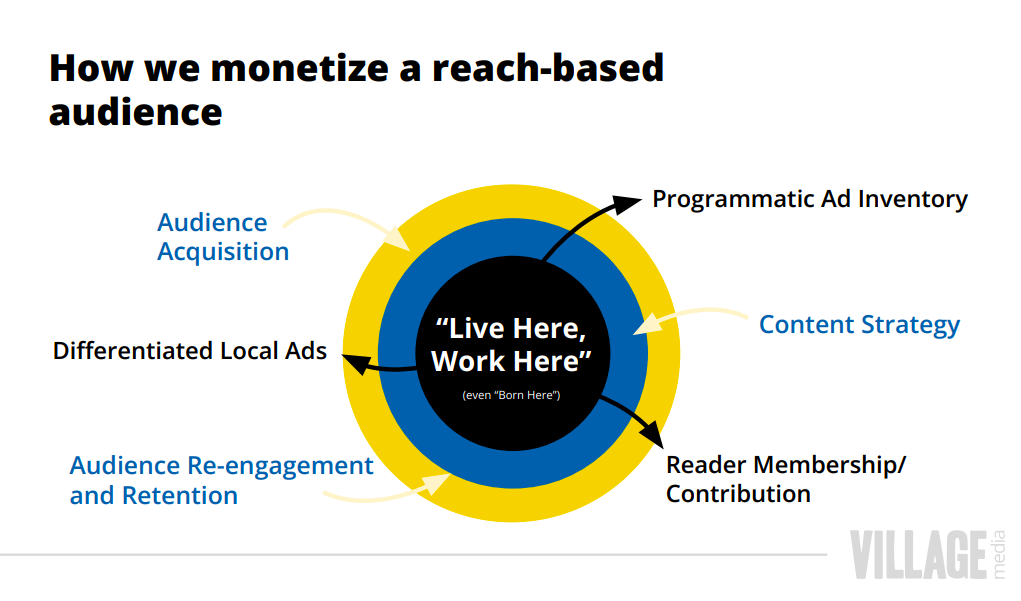
This strategy relies on aggressive audience acquisition, using everything from paid search and social media advertising to billboards and direct mail to build awareness and drive traffic into acquisition funnels.
By targeting communities with a strong sense of local identity where residents truly “live and work,” the model creates a habit-forming product that keeps readers returning.
Monetisation is achieved through a diversified product mix that prioritises local relevance over restrictive paywalls. Approximately 70% of revenue is generated by direct, on-the-ground local sales teams, complemented by programmatic advertising and a voluntary reader contribution program rather than mandatory subscriptions.
The company leverages the “Live Here, Work Here” affinity of its readers to offer differentiated local advertising products – such as business profiles, listings, and auctions – which provide measurable value to local businesses that would be impossible to capture through standard display ads alone.
This reach-based architecture ensures that Village Media acts as a local utility, where high-intent traffic from service-oriented content drives the commercial performance necessary to fund the company’s deeper community impact initiatives
How service journalism works for Village Media
Service journalism serves as the operational and financial backbone of Village Media, acting as a “local utility” that provides essential, daily information such as weather reports, traffic updates, business closures, and event listings.
Rather than being viewed as secondary, this content is prioritised because it attracts large, repeatable audiences and successfully combats “news avoidance” by offering information readers need to navigate their daily lives.
By focusing on these practical daily needs, Village Media builds a consistent habit among readers, slowly converting passive, casual users into more engaged consumers of the company’s deeper investigative and civic reporting.
Operationally, this model thrives on efficiency and scale. Village Media utilises a centralised news desk to manage routine tasks – such as rewriting press releases, moderating comments, or aggregating obituaries – across all 27 communities, which allows local reporters to focus exclusively on high-value original journalism.
This mix of content is vital to the company’s profitability; for instance, while original journalism accounts for 22% of page views, it requires a staff of 200, whereas obituary aggregation drives an equal 22% of page views with only two full-time employees.
Ultimately, this balance of high-volume service journalism and specialised reporting creates an essential community resource that drives both high-intent traffic for advertisers and the necessary scale to sustain professional local news.
Village Media’s own social media channel: Spaces
Spaces” is Village Media’s hyper-local community interest network, designed to function as a passion-focused alternative to global social media platforms like Facebook or Nextdoor. Rather than hosting inflammatory political debates, Spaces is organised around specific local interests – such as gardening, live music, cycling, or hockey – creating a digital environment that effectively crowd-sources a community-driven form of service journalism.
These spaces are primarily managed by local enthusiasts and subject-matter experts rather than journalists, fostering authentic community participation while keeping moderation requirements low. The platform is deeply integrated into Village Media’s main news sites through navigation widgets and cross-linking, ensuring a seamless flow of information between editorial content and user-driven discussion.
Furthermore, Spaces emphasises safety through rigorous account validation and the use of real names, which eliminates trolling and incentivises constructive, real-world connections. This commitment to offline impact is evident in the platform’s ability to drive real-world events, such as reading clubs, car meetups, and wellness workshops, all while remaining fully integrated with the company’s “Village Gold” commercial product suite.
AI at Village Media
At Village Media, artificial intelligence is deployed as an operational force multiplier designed to drive efficiency rather than to replace human journalism. The company focuses on using AI to help local editors quickly identify important information within the community.
A core technical application involves using AI to analyse large documents and datasets, such as 380-page City Council agendas, which allows the system to extract key local issues, compare them against historical coverage, and suggest relevant story angles and interview questions for reporters.
Furthermore, Village Media leverages AI to assist in light editing, generate community polls, suggest questions to precede comment threads, and moderate discussions. Beyond the newsroom, AI evaluates content based on archives and historical performance to help the company understand deep engagement beyond simple page views.
These tools extend to driving operational efficiency across the entire organisation, including advanced reporting for client services, prospecting tools for the sales team, and optimised workflows for the sponsored content studio. Ultimately, these applications allow journalists to focus on high-value tasks – such as talking to people and gathering information – that AI cannot replicate.
Next up: Launching a ‘Community Operating System’
Village Media is currently developing the world’s first “Community Operating System” (COS), a project designed to serve as a living civic infrastructure.
This advanced initiative leverages artificial intelligence across the organisation’s entire technological stack, integrating the “Villager” news platform, the “Spaces” hyper-local social network, and internal tools. Beyond optimising internal operations, the COS aims to create a unified platform that connects journalism, civic conversation, and public participation.
A primary feature currently in development is a supercharged resource directory that utilises a conversational chatbot to provide citizens with immediate, verified access to essential local support services — including housing, food, mental health, addiction, and domestic violence support.
This tool is being built in close cooperation with a network of community organisations and agencies, with a market launch expected in the coming months.
Our next Innovate Local webinar will take place on 27 May. Click here for details and to register.