Stig Ørskov to EU Speakers of Parliaments: Let’s live up to our shared responsibility
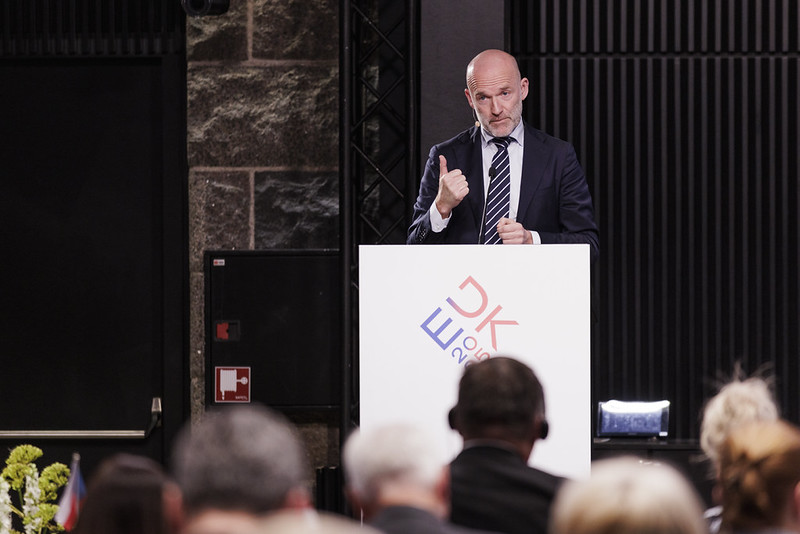
From 3-5 May, politicians from across Europe have gathered in Copenhagen for the Conference of Speakers of the EU Parliaments (EUSC), hosted by The Danish Parliament. WAN-IFRA CEO Stig Ørskov was invited to speak in a session focused on “Democratic Resilience in Times of Change,” exploring how parliaments can respond to misinformation, foreign interference and declining trust in institutions. The following is an edited version of his speech.
Let me start by making two things very clear as a representative of the world’s independent media:
- You and I play for different teams.
- But we fight for the same goals.
We want to strengthen democratic resilience. We want citizens to trust democratic institutions. And we want citizens to take part in democracy on an informed basis – based on facts.
We all know this is not easy.
We are living in a time of increasing prevalence of misinformation – accelerated by AI. At the same time, trust in institutions is weakening. That is the case for both political institutions and media institutions.
We are in an age where citizens often trust individuals more than institutions. For better – and for worse.
Even though we share the same goals, it is essential to understand one thing: We can only reach these goals if we understand – and respect – the fundamental differences between the role of parliaments and the role of the press.
On the one hand, we have a shared responsibility to ensure an informed public, based on facts.
On the other hand, we also have a shared responsibility to make sure citizens trust that politicians and the independent journalistic media are not in the same boat.
Citizens must feel confident that the press is holding you and your colleagues in the European parliaments accountable – on their behalf.
And they will only feel that confidence if the press is truly free from influence from the politicians it must scrutinise. That is why it is so important that you as politicians are able to control one of your natural instincts … the control instinct.
The idea of a strong correlation between press freedom and trust in government goes far back.
Think about John Stuart Mill, Voltaire, and Rousseau. For them, freedom depended on access to reliable information.
And with Montesquieu and the separation of powers came the idea of the press as a “fourth estate” – a power that monitors government, exposes abuse, and creates transparency.
Put very simply: Society needs someone to hold those in power accountable.
As your former colleague, the former speaker of the Danish Parliament, Erling Olsen, once said:
“It is the dirty press that keeps democracy clean.”
The statement captures the essence of the societal benefits of free press.
The press exposes irregularities. And it also works as prevention.
Because let us be honest: If any of you were considering dirty tricks of any kind – which, of course, none of you are – but if you did, the thought of ending up on the front page of Bild or The Sun would probably make you think twice.
By the way, that is exactly why I believe tabloid media are far more important to society than they are often given credit for.
The connection is clear:
- Press freedom enables scrutiny of power
- Scrutiny creates accountability
- Accountability increases trust in institutions
This is also why UNESCO has designated May 3 as World Press Freedom Day – to remind governments of their obligation to uphold and respect press freedom.
As I speak, many of my colleagues are actually in Lusaka, Zambia, attending this year’s World Press Freedom Conference. Which, by the way, has ended up as a messy affair due to political interference.
Now, I am fully aware that many of you have mixed experiences with the press.
Many of you have probably felt treated unfairly. Some of you may have faced stories about yourselves that were not based on facts.
That is a real problem. And it is a problem we must take seriously.
Let there be no doubt: The role of the press is, as one of the journalists behind the Watergate investigation, Carl Bernstein said, to seek “the best obtainable version of the truth” – through evidence-based work, listening to sources, and providing context.
At a time when democracy is in decline and autocrats are gaining ground around the world, this task – simple in principle, but difficult in practice – has never been more important.
If we are in doubt, we can turn to Hannah Arendt, one of the most important thinkers on totalitarianism.
She was very clear:
“If everybody always lies to you, the consequence is not that you believe the lies, but rather that nobody believes anything any longer.”
Unfortunately, it has never been easier to lie. Because today, media is much more than journalism done by independent media adhering to strong ethical values.
With social media, we now have platforms that are not focused on facts or truth. They are solely focused on maximising audience attention.
Their goal is to keep users engaged – and to increase advertising revenue.
This development has had clear consequences.
For journalism, it has meant a massive loss of advertising revenue – revenue that used to fund quality journalism.
For democracy, it has meant that citizens are exposed to far more misinformation since Gutenberg invented the printing press.
And yes – also from politicians.
Let’s be honest: Many politicians have found it hard to resist the temptation to use social media to spread their messages free from scrutiny – including messages where traditional media are described as “the enemy of the people.”
Without social media, we would likely have different political leaders today. And we would certainly have less misinformation – and stronger democratic resilience.
And now AI is accelerating this development.
Let me be clear: I am not against social media. They have made it possible for everyone to share their views without gatekeepers. That is powerful. But they have also created serious problems that we must address.
So, what do we do?
First, a piece of good news. Many independent media are doing better than ever.
If we look at newspapers like New York Times, Le Monde, El País, Die Zeit, and the Wall Street Journal, they are delivering strong financial results and hiring more journalists.
Why?
Because they have cracked the code of the digital subscription business.
The model is simple: With high-quality, credible content, they make people pay attention – and pay for the content. People are willing to pay for access to information they trust.
Not all media are in a strong position – especially local and regional media have faced challenges. But even here, we are starting to see signs of recovery.
So, there is still a strong foundation to build on.
And we know the key facts:
- Free media and media pluralism increase trust in democratic institutions
- Trust in media strengthens democratic resilience
So our task is clear:
First, we must ensure media freedom and pluralism.
Second, we must ensure trust in the media.
You, as leading politicians, carry a large part of the responsibility for the first. You have a significant influence on how free the media are. This is where you must control your instinct to control.
And this is also where you must ensure that state-controlled media do not become too dominant – or become tools that can be misused by those in power, as we have seen happening – even in Europe in recent years.
In addition, you influence the regulatory conditions that define the interaction of responsible media with the big tech platforms.
As a society, we need you to help ensure a level playing field.
We, in the media, carry the main responsibility for the second part: the task of increasing trust in media.
This requires a strong ethical compass. It requires that we react firmly to misinformation and lies. It requires self-regulation.
But it also requires one more thing, and perhaps most importantly: We, as independent media, must stay relevant. We must earn people’s attention. And eventually – we must earn their willingness to pay.
Because, and this is one of my fundamental beliefs: Truly independent media are financially independent media. And without truly independent media we can’t serve our role of being the public’s truly reliable watchdog – and keeping democracy clean.
As one of the grandfathers of democracy, Thomas Jefferson, the main author of the US Declaration of Independence once wrote:
“If I had to choose between a government without newspapers, or newspapers without a government, I would not hesitate to prefer the latter.”
In conclusion, we share the same goal.
But we have different roles.
And if we respect that, we give democracy its best chance to stay strong.
And in that light, yesterday, the World Press Freedom Day, was as much a day of celebration for all of you as it was for my members.
Celebrating World Press Freedom Day is also celebrating democracy – and the institutions that uphold it.
Not least, the institutions you are responsible for. From the bottom of my heart: thank you to all of you for taking that responsibility.