Best Smartwatch for Fitness Cycling – Buyer’s Guide 2024
Finding the right smartwatch for cycling comes down to three things: can it track your rides accurately, will it survive your rides, and will you actually use it. I’ve spent the last few months testing dozens of wearables on the road and trail to figure out which ones are worth your money.
This guide covers the best options for different types of riders—from casual weekend cyclists to anyone training for ultra-endurance events. Let’s skip the marketing fluff and get into what’s actually useful on two wheels.
What Actually Matters for Cycling Smartwatches
Before looking at specific models, know which features make a difference during actual rides. Plenty of watches look impressive in product listings but fail once you’re out riding.
GPS accuracy is the baseline. If your watch can’t track your route and distance correctly, nothing else matters. Most modern watches use multi-band GPS, connecting to multiple satellite systems at once. This makes a real difference in areas with heavy tree cover or tall buildings blocking the signal.
Battery life matters more than you’d think. Planning a long ride? The last thing you want is your watch dying at mile 60. Some watches have battery saver modes that extend runtime significantly, though they often reduce GPS update frequency or shut off sensors.
Water resistance catches many cyclists off guard. Rain happens. Sweat happens. Sometimes you take a shortcut through a creek. Most cycling-focused watches offer at least 5ATM water resistance, which handles rain and splashes without issue.
Heart rate monitoring has improved but isn’t perfect. Optical sensors on the wrist work reasonably well for moderate riding. During hard efforts or when the watch sits loose on your wrist, accuracy drops. If you’re doing structured training, chest strap compatibility becomes worth considering. Most cycling watches support both ANT+ and Bluetooth sensors.
Training metrics vary widely. Some watches give you basic pace and distance. Others offer VO2 max estimates, recovery recommendations, training load analysis, and downloadable workouts. The difference between a tracker and a training tool comes down to these features.
Strava integration is practical, not optional. Auto-syncing rides, seeing segment efforts, and keeping your training log in one place matters more than you’d expect until you’re manually uploading rides every time.
How We Tested These Smartwatches
These watches got tested in real cycling conditions, not labs. I rode them on flat city routes, mountain climbs, gravel trails, and indoor trainer sessions.
Each watch spent at least two weeks in regular rotation before evaluation. I tracked how fast GPS locked on, compared recorded distances against known routes, checked heart rate accuracy against chest straps during intervals, and pushed battery life to its limits with continuous GPS recording.
I also evaluated companion smartphone apps, sync reliability with Strava, and how easy it was to customize data screens while riding. A technically capable watch that’s frustrating to use during actual rides doesn’t make this list.
Best Overall Smartwatch for Cycling: Garmin Fenix 7 Pro
The Garmin Fenix 7 Pro is the current benchmark for cyclists who want one watch to do everything. It was built for multi-sport athletes who need serious data without sacrificing everyday wearability.
GPS accuracy matches or beats dedicated cycling computers in challenging terrain. The built-in TopoActive maps show terrain contours and points of interest without needing your phone—a genuine advantage when exploring new routes.
Battery life reaches 22 days in smartwatch mode and 73 hours with GPS running. That drops when you stream music and use maps actively, but even heavy GPS use gets you through a full week of riding between charges. For multi-day bikepacking, this battery performance changes what you can attempt.
Training readiness combines sleep, recovery, and recent training load into a daily recommendation. It’s not flawless, but it gives useful guidance on whether today should be an easy spin or a hard effort. ClimbPro automatically generates gradient profiles for mapped routes, showing exactly what’s coming on scheduled climbs.
The $700 price tag for the Sapphire Solar edition isn’t small. The combination of rugged build, comprehensive features, and genuinely useful training tools justifies the cost for serious cyclists. The titanium case and sapphire crystal handle rough use without showing significant wear.
Best Battery Life for Long Rides: Garmin Enduro 2
For ultra-endurance cyclists where battery life is the priority, the Garmin Enduro 2 stands alone. It runs for months in smartwatch mode and records up to 150 hours of continuous GPS.
That battery life comes from efficient processing, a large solar-charging display, and smart power management. You could ride an event like the Tour Divide without worrying about your watch dying.
The Enduro 2 shares most training features with the Fenix line—ClimbPro, training readiness, multi-band GPS. The always-on MIP screen stays readable in direct sunlight, a real advantage over OLED when you’re descending at speed and need to glance at data.
The build is even more rugged than the Fenix, with a reinforced strap designed to stay secure in rough conditions. At around $800, it costs more than many cycling computers. For riders who need absolute reliability over extended adventures, nothing else comes close.
The tradeoff is weight and bulk. The Enduro 2 feels substantial on your wrist. If you mostly ride in normal conditions and want something lightweight for daily wear, this might feel excessive. But for its intended use—ultra-endurance riding—the extra mass becomes irrelevant once you’re focused on the ride.
Best for iPhone Users: Apple Watch Ultra 2
iPhone users have a real alternative to Garmin, and it’s surprisingly capable. The Apple Watch Ultra 2 wasn’t designed specifically for cycling, but it has evolved into a genuinely useful cycling companion when paired with an iPhone.
The dual speakers produce loud audio cues that remain audible at speed. Apple Maps gives turn-by-turn directions during rides, with haptic feedback before intersections. Precision finding helps locate your parked car or starting point accurately.
GPS accuracy matches dedicated cycling computers in most conditions. The watch records distance, pace, and elevation reliably. Cellular models let you leave your phone behind while staying connected for emergencies and music.
The limitation is third-party integration. Strava and other cycling apps work, but they don’t integrate as deeply as Garmin’s ecosystem. The Workout app has good structured workouts, but the watch lacks advanced training metrics like training load focus and heat altitude acclimation that Garmin offers.
Battery life maxes out around 36 hours in low-power mode with GPS—fine for most rides but short for ultra-distance events. For typical road and trail riding up to six hours, it works well.
At roughly $800, the Ultra 2 costs about the same as top Garmin models. If you’re already in the Apple ecosystem and want everyday smartwatch functionality alongside cycling tracking, it’s a solid dual-purpose choice.
Best Value for Serious Cycling: Garmin Forerunner 965
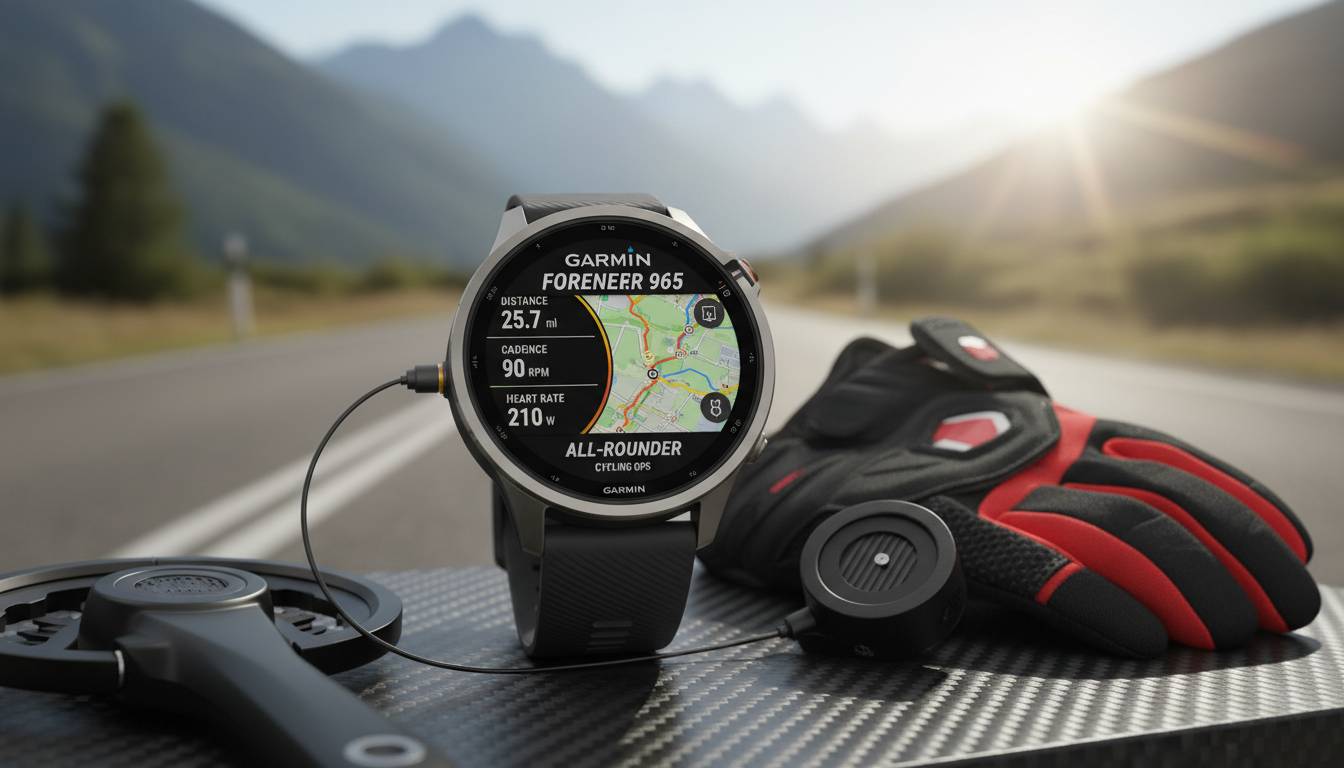
The Garmin Forerunner 965 bridges the gap between bulkier Fenix designs and minimal sports watches, offering nearly all the cycling features in a lighter, more affordable package.
This watch focuses on running and cycling without the multi-sport features of the Fenix. That specialization means impressive cycling capabilities in a package that weighs less and looks more like an everyday watch.
The 1.4-inch AMOLED display produces vivid colors and reads well in all lighting. AMOLED traditionally uses more power than MIP screens, but the Forerunner 965 still manages about 23 days in smartwatch mode and 31 hours with GPS running—plenty for regular riding.
Mapping includes turn-by-turn navigation and ClimbPro. Plot routes on your phone, sync to the watch, and get guidance on upcoming climbs with grade breakdowns. This feature alone has changed how many cyclists approach hill training.
At around $600, it’s noticeably more accessible than the Fenix while delivering nearly equivalent cycling functionality. Tradeoffs include slightly less rugged construction and no multi-sport features like dedicated swim tracking or golf course maps.
For cyclists who want serious training features without the outdoor-oriented bulk of the Fenix, the Forerunner 965 hits the sweet spot.
Best Budget Cycling Smartwatch: Garmin Forerunner 55
Not everyone needs to spend hundreds on a dedicated cycling watch. The Garmin Forerunner 55 shows that core cycling tracking doesn’t require premium pricing.
This watch captures essential metrics reliably: pace, distance, time, and heart rate. GPS acquisition proved fast and accurate in testing, matching more expensive competitors on basic ride tracking. Daily suggested workouts adapt to your fitness level, providing structured training without manual programming.
Battery lasts about two weeks in smartwatch mode and up to 20 hours with GPS running. That’s enough for most recreational riders and covers rides well beyond typical attention spans.
Limitations appear with advanced training needs. No mapping, no ClimbPro, no power meter connectivity. Recovery recommendations give basic guidance but lack the sophisticated analysis of higher-tier models.
At around $200, the Forerunner 55 costs roughly a quarter of top-tier alternatives. For cyclists who want reliable ride tracking without technology becoming the focus of their riding, it delivers real value.
Smartwatch vs Cycling Computer: Which Do You Need?
This genuinely divides cyclists, and the answer depends on your situation.
Cycling computers like Garmin Edge or Wahoo Elemnt offer larger displays, more sophisticated mapping, and deeper sensor integration. If cycling is your main sport and you want maximum data visible at a glance, dedicated units often win. Bigger screens show more fields without wrist rotation, and handlebar mounting keeps information constantly visible.
Smartwatches win when cycling isn’t your only activity. If you also lift weights, run, swim, or play sports, one watch tracking everything beats switching between devices. Everyday wearability means you’re more likely to capture baseline health data like sleep and steps.
Smartwatches also offer notifications, music control, and smartphone connectivity that cycling computers can’t match. Want to take calls or reply to messages during rides? A smartwatch handles this while cycling computers stay purely data-focused.
Many serious cyclists end up using both—a cycling computer for structured rides where data visibility matters most, and a smartwatch for everyday wear and non-cycling activities. This combo isn’t cheap, but it provides the best experience in each context.
For most recreational cyclists, a quality smartwatch handles tracking needs adequately. The convenience of wearing one device rather than planning around a cycling computer installation often means more rides actually get logged.
Key Features to Look for in a Cycling Smartwatch
Beyond basic GPS tracking, certain features separate genuinely useful cycling watches from expensive trackers that gather dust.
Multi-band GPS dramatically improves route accuracy in challenging environments. Watches supporting GPS, GLONASS, and Galileo consistently beat single-constellation alternatives, especially under tree cover or near buildings.
Sensor connectivity through ANT+ and Bluetooth enables chest straps, power meters, and additional devices. Even without these sensors now, having flexibility to add them later extends your watch’s useful lifespan.
Training load and recovery analysis helps prevent overtraining. The best watches combine acute training stress with longer-term fatigue tracking, guiding intensity decisions.
Customizable data screens let you see exactly what matters during rides. A watch that forces scrolling through irrelevant metrics during hard efforts frustrates more than helps.
Weather and altitude tracking matters more than expected. Temperature affects heart rate accuracy, and altitude data provides context for effort levels during climbing.
Strava integration should be seamless. Auto-syncing rides, seeing live segments, and accessing your complete ride history within Strava significantly impacts how useful the watch becomes.
Conclusion
Choosing the best smartwatch for cycling comes down to matching features to your riding habits and budget. The Garmin Fenix 7 Pro earns the top spot for cyclists wanting maximum capability without serious compromise—its accuracy, battery life, training features, and build quality remain unmatched.
If battery life during ultra-endurance events drives your decision, the Garmin Enduro 2 stands alone. For iPhone users embedded in Apple’s ecosystem, the Apple Watch Ultra 2 delivers impressive cycling functionality alongside everyday smartwatch excellence.
The Garmin Forerunner 965 provides the best value for cyclists prioritizing serious training features without the Fenix premium. And the Forerunner 55 proves that core cycling tracking needn’t break the bank.
Whatever you choose, the best watch is the one you’ll actually wear and use consistently. Features only matter if they translate into rides logged, training executed, and improvement measured over time.
FAQs
Do I need a smartwatch specifically designed for cycling, or will any GPS watch work?
Any GPS watch can track basic ride metrics, but cycling-specific models offer advantages in battery optimization, data fields designed for cycling, and sensor integration. If cycling is your primary activity, dedicated cycling features provide meaningful benefits.
Can I use Apple Watch for serious cycling training?
Yes, the Apple Watch Ultra and Ultra 2 offer excellent GPS tracking and work well with Strava and other cycling apps. However, advanced training metrics like training load analysis and heat acclimation remain limited compared to Garmin’s ecosystem.
How long should smartwatch battery last for cycling?
For GPS tracking, expect at least 15 hours from quality watches. Extended battery modes can significantly extend this. If you regularly ride longer than your watch’s GPS battery life, consider models designed for ultra-endurance or carry charging options.
Is Strava integration automatic on cycling smartwatches?
Most modern cycling watches offer automatic Strava sync through their companion apps. However, verify this before purchasing if maintaining your Strava log automatically matters to you. Some models require manual upload steps.
Do I need a chest strap if my watch has optical heart rate?
For casual riding, optical wrist-based heart rate is usually adequate. However, during high-intensity efforts or interval training, chest straps provide significantly more accurate readings. Most cycling watches support both ANT+ and Bluetooth chest straps if you want to upgrade later.
What’s more useful: mapping on the watch or on my phone?
Having maps on the watch eliminates the need to mount your phone for navigation, which many cyclists prefer. However, phone navigation apps often offer more sophisticated routing options. Consider whether you want to navigate unfamiliar routes without carrying your phone.
Visited 834 times, 1 visit(s) today